Australian Electrical Wire Colours: Single Phase, Three Phase, & Legacy Codes Explained
28Nov
Ahmed Tayeh
Standards & Compliance
Australian Electrical Wire Colours: Single Phase, Three Phase, & Legacy Codes Explained
Wire colours in Australia are not a matter of convention. Every colour code used in an electrical installation must comply with AS/NZS 3000:2018.
✓ Getting them right prevents fatal misidentification.
X Getting them wrong can mean shock, fire, failed inspection, or someone's life.
This guide covers every wire colour used in Australian electrical installations: single-phase, three-phase, DC systems, solar PV, flexible cords, and legacy wiring. It also covers what to do when you encounter wiring from multiple eras in the same installation.
Why Do Wire Colour Codes Matter in Australia?
Following Australian electrical wiring colour codes is a legal requirement under AS/NZS 3000:2018. The purpose is straightforward: colour coding lets any licensed electrician immediately identify the function of every conductor without testing.
This matters at installation. It matters more during fault finding, modifications, and emergency work, when accuracy is the difference between a safe outcome and a serious incident. Wire colour coding is the first line of defence in electrical safety. It helps reduce the chance of incorrect wiring by distinguishing live, neutral, and earth conductors.
All installations should feature warning signage where circuits or fixed cables use mixed-colour wires, prominently displayed on either the fuse board or the consumer unit.
What Is the Australian Standard: AS/NSZ 3000:2018?
In Australia, electrical wiring colours are governed by AS/NZS 3000:2018. This standard ensures that every wire in a circuit can be quickly and accurately identified, whether it's carrying live power, returning current, or providing a safe earth connection.
Australia updated its wiring colour codes around the year 2000, aligning with international standards set by the International Electrotechnical Commission (IEC 60445). Subsequent updates in the AS/NZS 3000:2018 edition reinforced these modern colour codes.
Brown replaces the former red for active wires
Blue replaces the former black for neutral wires
Green/yellow striped is now mandatory for all earth wiring, formerly solid green
These changes align Australia with global electrical practices and enhance cross-border safety and product compatibility.
What Are the Current Wire Colours in Australia for Single-Phase Systems?
Single-phase power is the standard for residential homes and most small commercial premises across Australia. The majority of 230 V circuits use this three-wire system.
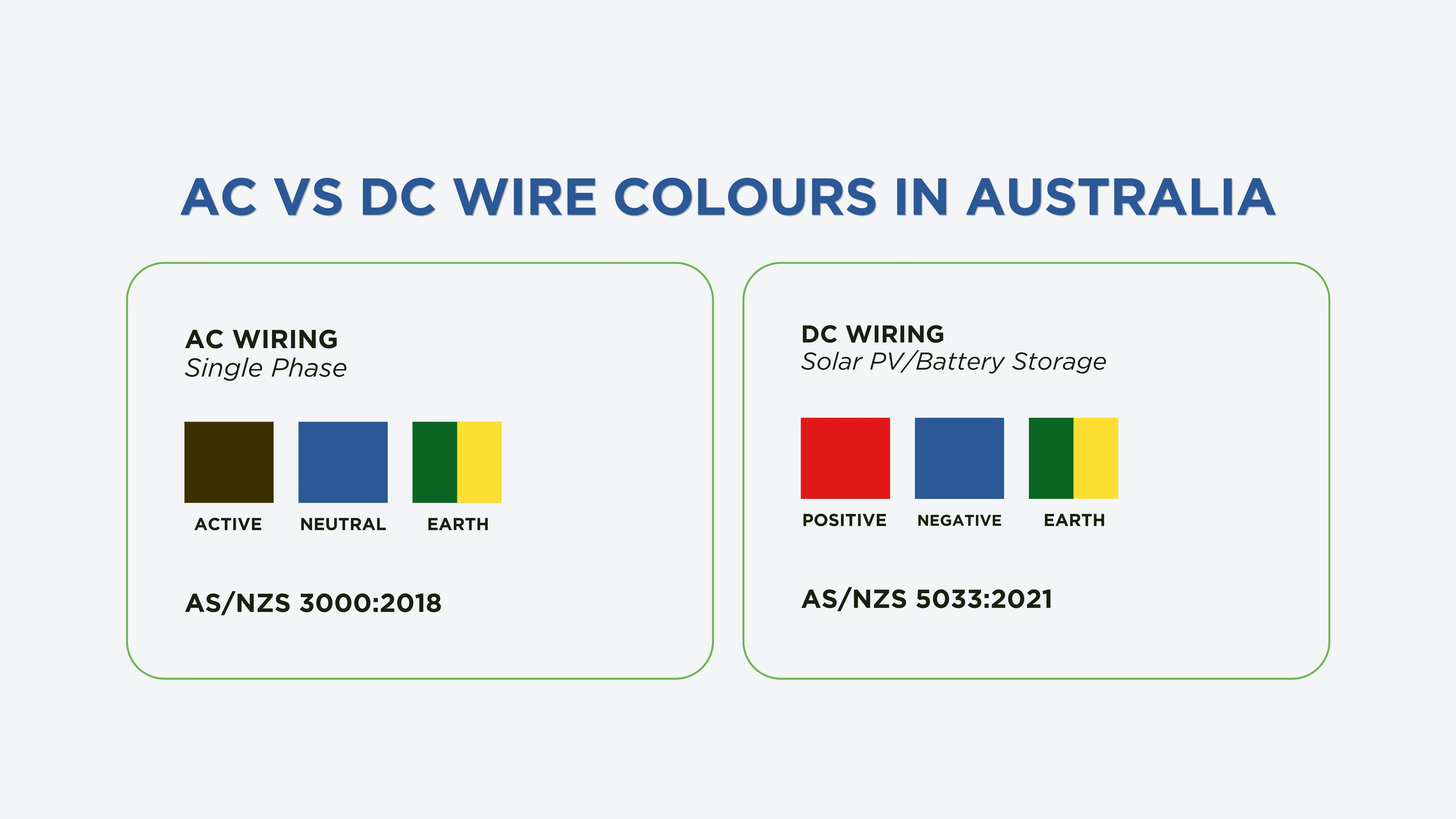
Active (Brown): The active conductor carries voltage at all times when the circuit is live. It is the most dangerous conductor to work on. Brown is the mandatory colour under AS/NZS 3000:2018 for all new single-phase installations.
Neutral (Blue): The neutral conductor completes the circuit by returning current to the source. Neutral is classified as an active conductor under AS/NZS 3000 because it can carry voltage as the return path for single-phase circuits.
Earth (Green/Yellow Stripe): The earth conductor provides a low-resistance path for fault current to flow safely to ground, protecting both equipment and people in the event of a fault. The green/yellow stripe pattern was adopted for colour-blind accessibility.
What Are the Current Wire Colours in Australia for Three-Phase Systems?
Three-phase power is used in commercial buildings, industrial facilities, large air conditioning systems, motors, and any application requiring higher power capacity.
The Most Dangerous Colour Reversal: Black
This is the most critical point for anyone working with Australian three-phase systems, particularly those who trained or worked under the old colour standards.
Under the old standard, black was neutral. Under the current standard, black is a live phase conductor (L2). This is the most dangerous colour reversal in Australian electrical history. In any installation where the age or modification history is uncertain, always test before you touch.
Grey (L3) is also a live conductor. It has no equivalent in the old single-phase colour system, but it can be confused with older neutral and earth conductors in poorly labelled installations.
What Was the Legacy System Pre-2000 Wire Colours in Australia?
Many Australian buildings, particularly those built before 2000, still contain wiring installed under the old colour standards. Understanding these legacy colours is essential for safety and for compliance when modifying or extending older installations.
What Are the Rules When Working With Legacy Wiring?
Older wiring doesn't need to be replaced just because it uses the old colours, as long as it was compliant at the time of installation and remains in good condition.
However, any new work, repairs, or upgrades must use the current colour codes. Where new wiring connects to legacy conductors at a junction or termination, the installation must be clearly labelled at every point where mixed-colour systems meet.
The age of the property is not a reliable indicator of what wiring colours are present. Previous unlicensed repairs, partial rewiring, or additions by past tradespeople can introduce any combination of old and new colours into the same installation. CEdit.5.2.webp153.85 KB
What Are the DC Wire Colours in Australia?
DC wiring, used in solar photovoltaic systems, battery energy storage, and EV charging, uses a different colour convention from AC wiring. The governing standard for solar PV installations is AS/NZS 5033:2021.
Critical Point
In DC systems, red is positive (live) and black is the negative return This is an important distinction from the AC three-phase system, where black is also used but as a live phase conductor. Electricians working across both AC and DC systems on the same site must be alert to this context-dependence.
DC circuits in solar PV installations are energised by sunlight. They cannot be isolated by simply opening a switch. Colour coding helps identify conductors, but it is never a substitute for proper isolation and testing procedures.
What Are the Wire Colour Exceptions Under AS/NZS 3000?
AS/NZS 3000:2018 includes specific provisions for situations where standard colour coding cannot be applied or where legacy conditions exist.
Previously Installed Earthing and Bonding Conductors. Where modifications create new terminations with existing bare earth conductors, those conductors must be sleeved in green/yellow at every new termination point created during the work.
Pre-Existing Yellow Conductors. Yellow is not part of the current Australian colour standard. Where existing yellow conductors are present in an installation being modified, they must be sleeved in white at every new termination.
When Protective Earthing Conductors Don’t Need Green/Yellow. A protective earth conductor doesn’t need to be green/yellow if:
It is an aerial or bare conductor used as a protective earth
It is a suitable metallic screen of a multicore cable used as a protective earth
It is an insulated conductor not manufactured in green/yellow. Green/yellow sleeving must be applied at all termination points
When Active and Neutral Conductors May Depart from Standard Colours. Conductors within a multicore cable are not required to follow the standard colour scheme individually if they are consistently identified by numbering or lettering throughout the installation.
Design Compliant Installations With CableHero
Knowing your wire colours keeps your installations safe. Sizing the cables correctly keeps them compliant and performing over their full service life.
CableHero is professional cable sizing software built specifically for Australian electricians and engineers. Whether you're designing a new residential fit-out, extending an older commercial installation, or sizing cables for a solar PV system, CableHero does the heavy lifting.
With CableHero, you can:
Size cables accurately for single-phase and three-phase AC circuits
Apply AS/NZS 3008.1.1 correction factors for ambient temperature, grouping, and installation method
Size DC cables for solar PV and battery storage systems
Generate compliant PDF reports and cable schedules ready for certification and DNSP submission
What are the current wire colours in Australia under AS/NZS 3000?
Under AS/NZS 3000:2018, the current wire colours for single-phase wiring in Australia are: brown for active (live), blue for neutral, and green/yellow stripe for earth. For three-phase systems, the colours are: brown (L1), black (L2), and grey (L3).
What were the old wire colours in Australia and why did they change?
Australian single-phase wiring used red for active, black for neutral, and solid green for earth. Three-phase systems used red (Phase 1), white (Phase 2), and blue (Phase 3), with black neutral and solid green earth. The colours changed to align with the International Electrotechnical Commission's IEC 60445 standard.
Is it safe to work on an older Australian home that still has red, black, and green wiring?
The old wiring is not inherently unsafe, but working on it without understanding the colour differences can be fatal. The most dangerous issue is that black means neutral in the old single-phase system, but live (L2) in the current three-phase standard.

 Product Guides